Bukom, a neighbourhood of Accra, Ghana is the home of boxing in Africa with its concentration of boxers who fight to escape the poverty of the ghetto.
By OLOLADE ADEWUYI (For TELL Magazine)
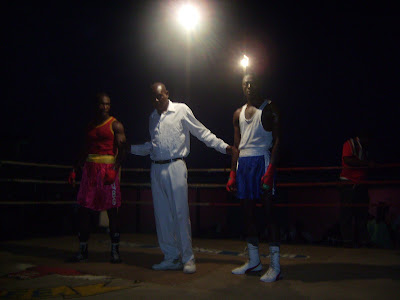 Fight night at Prisons Canteen, Accra
It is a cool evening at the Prisons Canteen, Danquah Circle, Accra where Thomas Azurie, a lanky Tema-born welterweight fighter is preparing to enter into the boxing ring. His coach George Neequaye helps to strap on his red gloves while giving him some last minute instructions. Azurie is heading into his third amateur fight after losing the two previous ones by points and a technical knockout courtesy of a bleeding nose respectively. He had approached the Billy Kotey Memorial Boxing Gym, Bukom three years ago to master the art of boxing which had so enthralled him as a kid. The 20 year-old has since come to feel at home under the tutelage of Neequaye. He was scheduled to fight Emmanuel Obeng, a stocky muscle-bound pugilist from the Attoh Quarshie Boxing Club. The crowd which consists of beer guzzling prisons officials and other enthusiasts have gathered round the square ring of the Prisons Canteen courtyard in anticipation of a great fight night. The rusty ring sits under the moonlight as the many boxers prepared themselves for their bloody sport. The ring looked like the ancient Roman Coliseum, a place which has seen the building of many professional careers and the end of many even before they had begun. Two 10 year-olds go at each other in the first bout of the night. The crowd screams in applause whenever a good punch is landed by any of them, even though it is a non-scoring fight. Neequaye gives his ward last minute advice before entering the ring. “He’s going to come at you with force but relax and take him out with your left hook”, he says.
 Thomas Azurie gets last minute instructions from coach George Neequaye.
The boxers commence and there is a flurry of punches as they size each other up. The first round ends with Azurie breaking his nose again, the scars of the past coming to haunt him. The doctor again stops him in the second round even though he wants to go on. The lad is flushed with anger. His coach tells him to calm down. “A loss at amateur level should not discourage a fighter because it is a learning curve”, he says. Azurie is painfully led away from the gym by Neequaye who tells him to resume training in two weeks after his nose heals up. Amon Neequaye, an Olympian at the 1984 games in Los Angeles sums up the spirit of the Bukom boxer; “They are courageous and persistent”.
 Front of the Billy Kotey Memorial Boxing Gym, Bukom, Accra
.
Hail a taxi cab anywhere in Accra; destination- Bukom and the cabbie will most probably ask which boxing gym you want to visit. Boxing is the major pastime of the young men of Jamestown and Bukom in downtown Accra while every foreigner is perceived as a would-be student. The gyms of Bukom attract the attention of boxing practitioners from Europe with many making regular pilgrimages to test their strength against the will of Bukom’s fighters. They sometimes donate fight equipment to the gyms to help keep them going. A United Kingdom, UK, sports company GAP organises yearly teaching exchange trips to Bukom for UK based athletes. The sport is what has put their small rusty town on the world map. Bukom is regarded by many as the boxing capital of Africa. From its small population has emerged some of the greatest boxing talents in the world. It is said that kids in Bukom learn to fight as soon as they can run because the law of the jungle holds sway here; eat or be eaten. There is a form of bullying which goes on in Bukom which many refer to as a toughening process for young boys in this town where poverty is as real as the stinking overflowing drains that ooze out of its shanty homes. But for many kids here, boxing is a ticket to the good life. Its almost 30 rundown boxing gyms have achieved the feat of producing toughened boxers on a regular basis and these have brought glory to the slum. From out of the shacks of Bukom have come such names like Azumah ‘Zoom Zoom’ Nelson, a three time World Boxing Council, WBC, featherweight title holder who is regarded by many as Africa’s greatest boxer; DK Poison, WBC featherweight champion; Clement Quartey, Ike Quartey, World Boxing Association, WBA welterweight champion; Alfred Kotey, WBO bantamweight champion; Raymond Narh, Commonwealth gold medallist and reigning International Boxing Federation, IBF, bantamweight champion Joseph “King Kong” Agbeko.
For many families in Bukom, boxing is a trade they take closely to heart. Boxing coach George Neequaye tells of how his family has been into the trade for a long time. The gym where he trains new fighters now was started by his father. His brothers and nephews have fought out of it their whole life. “I met it in the family”, says the portly 42 year-old Neequaye who presently has 10 students training under him. The Billy Kotey Memorial Boxing Club is, like many other clubs in Bukom, an open courtyard in the back of a colonial style building. It shares space with the women’s laundry line. Its punching bag, now removed, hangs from a weather-beaten wall. Some worn out boxers’ shoes lie around the concrete floor, the years clearly telling on them. The gym could as well have been an old clothes dump. But it’s a place that has produced great fighters, including a certain Raymond Narh, 1998 Commonwealth Games gold medallist now fighting professionally in the United States. “Raymond is my nephew, he trained here”, quickly points out Neequaye, who doubles as an officer of the Ghana Fire Service. For many in Bukom, boxing is a path to the promise of much wealth and escape from the ghetto where the worth of life is very cheap. With its high hopes comes the ugly underbelly. Neequaye tells sorrowfully of how another of his nephews, a young promising boxer was stabbed to death right around the corner after one of his fights. It is an incident that Neequaye remembers with pain and anguish written all over his face. He shows me a large framed photo of the deceased lad even as he avoids taking a look at it himself. “I can never look at that picture again”, he says. “It brings back bad memories”. Dauda Lartey, a young carpenter’s apprentice who used to be a boxer confirms the fears of many in his neighbourhood. “If you stay in this area and you’re not strong, you have no chance”, he says in a voiced laced in fatality. It is the proverbial no man’s land where fists are used to resolve differences between people, young and old. And when a fight arises, “nobody will separate them until one party runs away”.
The tough street training is one of the ingredients that helped shape Joseph Agbeko to become what he is today. The reigning 28 year-old IBF champion won his title after stopping Nicaraguan Luis Alberto Perez in the seventh round of a title fight in Las Vegas in November 2007. His story reads like typical rags to riches, his fist being his meal ticket out of the slum. “Bukom is the home of Ghana’s boxers because it’s where poor people come from and become rich”, he says.
 IBF Bantamweight champion Joseph 'King Kong' Agbeko, notice the tattoo on his arm
Agbeko began boxing at an early age like most other Bukom kids and enrolled for his first formal boxing classes with Attoh Quarshie Boxing Club at about ten years of age in 1990. “In Bukom, when children are fighting nobody separates them until one of them gets tired”, says Agbeko. His childhood instincts have made him into the best fighter in his weight category in the world. The lack of adequate training materials does not deter the Bukom lad from aiming for the world championship title. It is the largeness of their hearts Aand their great guts that have placed many on the ladder of success. “The people over there are very independent, they want to get to where they want to get to, and they don’t think too much about facilities, they aim high”, says Agbeko fondly called King Kong. Even though some boxing critics say that Ghanaian boxing is on the decline due to the impatience of boxers and coaches alike to want to make quick money, the fighters of Bukom have made a name for themselves out of the misery of daily life by letting their punches do the talking.


